
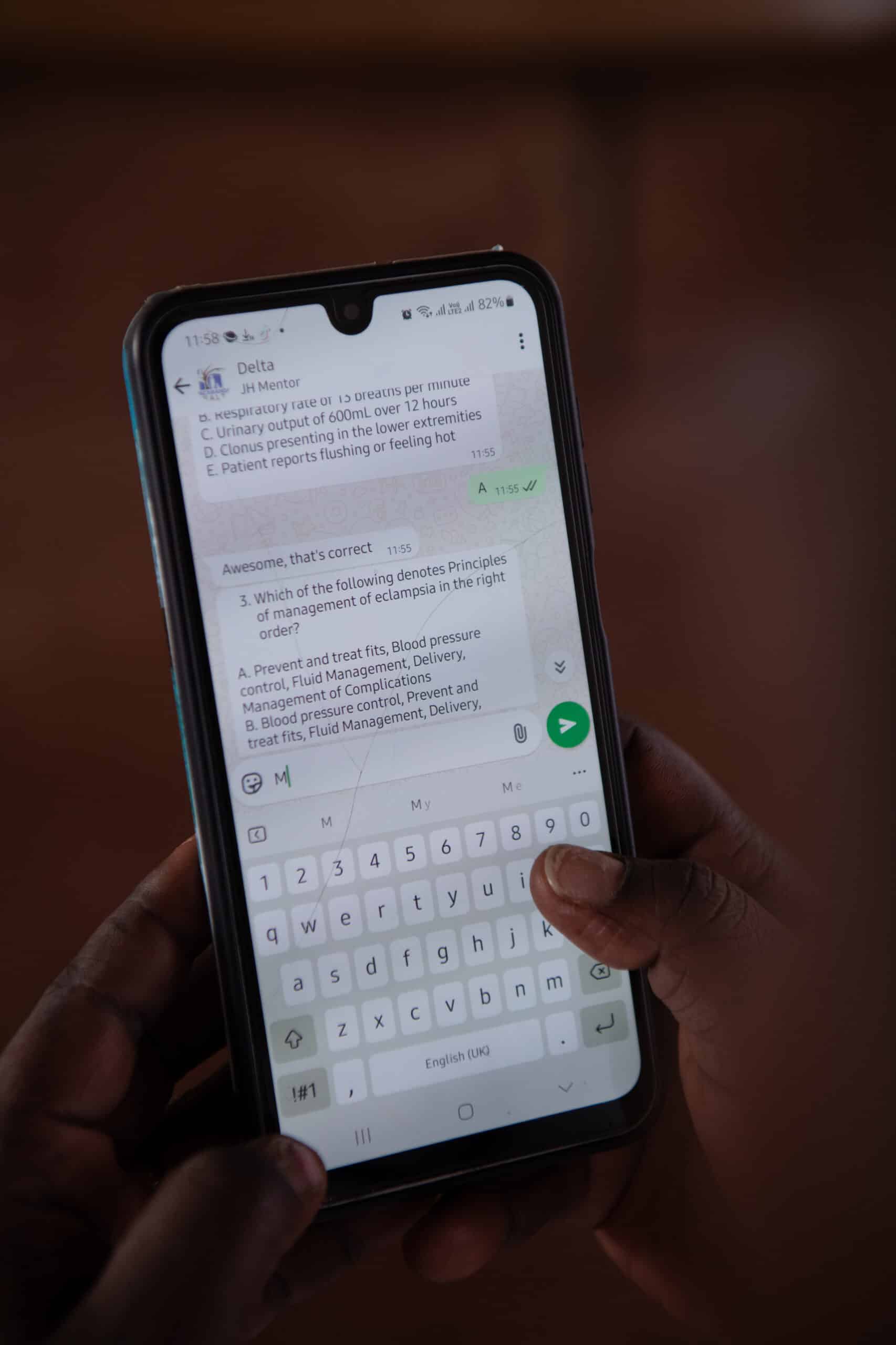
Every mother and newborn depends on a health provider having the right knowledge when it matters most, especially during emergencies. Yet many nurses and midwives struggle to access continuous, high-quality clinical training. Traditional, in-person mentorship cannot reach every provider who needs support – DELTA was built to help close that gap.
Delivered through WhatsApp, DELTA gives frontline maternity providers a flexible way to access accredited clinical learning wherever they are. Jacaranda Health first developed DELTA as a complement to in-person frontline provider training during COVID-19.
Today, we are excited to announce the launch of an advanced version of DELTA.
The first version of DELTA showed us that it was possible to deliver training over WhatsApp – and that it could be improved to be more inclusive.
DELTA has already digitally trained more than 12,800 frontline health providers in Kenya, and learners score more than 80% on average on Emergency Obstetric and Newborn Care (EmONC) knowledge tests. Digital delivery of the curriculum offers a significantly more affordable way to extend provider support, costing approximately 1/20th of in-person training.
Through the implementation of DELTA over the last several years, we have learned that:
- Providers are using DELTA at different stages of their career and with different gaps. A fixed pathway model has the potential to waste the time of someone who just needs help on one clinical step, and holds back someone ready for harder material.
- Providers need support beyond the structured modules. Clinical questions arise outside of what the curriculum offers and providers need answers they can trust in the moment, grounded in approved national protocols.
- It would be beneficial for DELTA to get smarter about each provider over time, using what it sees in their performance to decide what they need to learn next.
Our newly released, advanced version of DELTA incorporates adult learning principles and new, practical features for providers
Built and tested with nurses and midwives, this version builds on what worked in the first version while making digital learning more relevant, practical and responsive to frontline providers. The newest version of the platform addresses some of the learnings above, and now delivers:
- A broader clinical curriculum: DELTA now extends beyond Emergency Obstetric and Newborn Care to cover comprehensive newborn care, normal labour and delivery, antenatal and postnatal care.
- More engaging learning formats: Providers can learn through audio, video, visual job aids, interactive case studies and assessments, making learning more practical and easier to engage with on WhatsApp.
- Clinical Q&A: Providers can ask clinical questions as they arise and receive guidance grounded in updated national maternal and newborn health protocols and WHO guidelines.
- Learning linked to professional development: Providers can receive automated certification after completing modules, with each module equivalent to one CPD point.
These changes move DELTA from primarily delivering digital content to providing a more comprehensive learning and clinical support experience for frontline maternity providers.
Why DELTA matters
DELTA is now built to make continuous learning more accessible to frontline providers who cannot always be reached through traditional mentorship, and more responsive to what each provider already knows and where they need support. As the learning platform grows, Jacaranda aims to reach 15,000 providers annually across all 47 Kenyan counties by 2028.
The new infrastructure has also been designed so learning content can eventually be adapted to different national guidelines and contexts beyond Kenya. The previous version showed that frontline providers will engage with high-quality digital learning when it is accessible to them.
DELTA’s goal is to ensure that frontline healthcare workers have the knowledge and support they need to provide safe, respectful and high-quality care, so that more mothers experience pregnancy and childbirth safely and more newborns get a safe start in life.